



The Passion Project that Became a Mission: Andrea Rudnik’s Story
Written By: Bella Varghese ’26
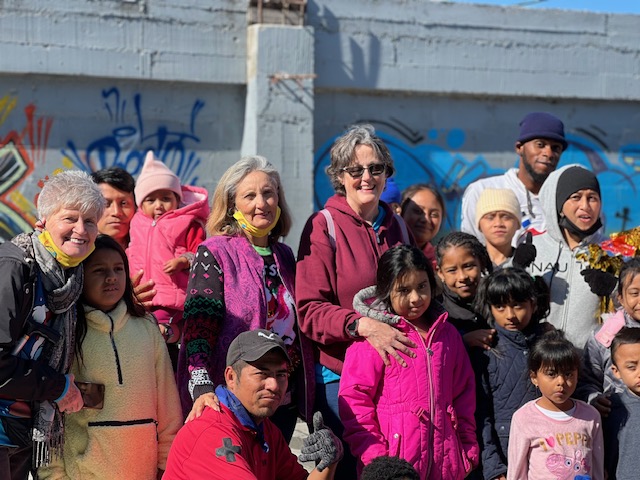
What started as a simple passion project providing resources for migrant people became a full-fledged mission in 2018. Leading this mission is Andrea Morris-Rudnik, a Doane Stuart School alumna (’78) and Hobart and William Smith College alumna (’82).
Her time at Doane Stuart School started in 1975, when her previous school, St. Agnes School, merged with Kenwood Academy to form Doane Stuart. As a high school sophomore, she was amazed by the dedication of the school’s nuns. “It just impressed me the way these women were so strong and just never quit. If they could do it, if they could work, if they could serve, they did,” she said. “I think my eyes were more open to service from that time.”
“Doane Stuart certainly provided a foundation for me as a teenager…that the world is at your doorstep, that you just have to look around and you just have to see who’s there,” she said, “see who’s your neighbor, and see who needs a hand or who you can provide assistance to.”
After graduating from college, Rudnik joined Volunteers for Mission, a program of the Episcopal Church, and spent two and a half years in Honduras. “Hobart and Williams Smith College has always had a big emphasis on doing volunteer service,” she said, explaining how she set down the path of volunteering.
There, in Honduras, she met her husband, adopted their oldest daughter, and gave birth to their second child.
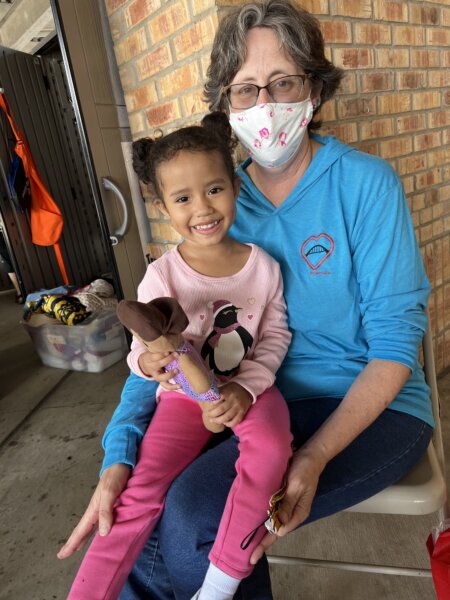 At the end of her mission, Rudnik and her family moved to Minneapolis, Minnesota to be closer to her husband’s family. After welcoming their third child, the Rudniks decided it was time to look for teaching jobs.
“We started looking for job opportunities,” Rudnik said. “They were recruiting very heavily in the [Rio Grande] Valley…they were recruiting very heavily, especially from the Midwest States. They just did not have enough teachers that the colleges here were putting out.”
In 1986, the Rudnik family moved to Brownsville, Texas and began their public school careers, as did many Midwest teachers. Brownsville is a border town in the southernmost part of Texas by the Rio Grande River.
“It’s a community primarily made up of recent immigrants or first generation,” Rudnik said, “where their parents have come and [their children] were born here.”
Rudnik and her husband were both teachers in Brownsville’s public school system. Rudnik served as a special education teacher, and her husband worked as a middle school teacher.
“At the very beginning, it was challenging, especially for my husband, who was teaching in middle school,” she said. “Middle school is kind of always challenging.”
Among the challenges Rudnik and her husband faced as teachers, the language barrier was most persistent. Neither Rudnik nor her husband were fluent in Spanish when they first started teaching in Brownsville.
“He wasn’t fluent in Spanish, and middle schoolers can kind of push your buttons, try to say things, especially if they think you don’t understand them,” she said. “They’ll use bad language and stuff like that in Spanish. And they did.”
Unlike her husband, Rudnik experienced this issue less frequently. As a special education teacher, she worked with early childhood students with visual impairments, teaching them how to read Braille.
Within the first two years of teaching in Brownsville, the Rudniks noticed just how many Midwest teachers were packing their things to leave.
“Many of the teachers that came down at the time that we did left very quickly. They left in a year or two. They just couldn’t handle it,” Rudnik said. “They would say they were in culture shock, that they didn’t understand Spanish, or that they just felt very uncomfortable here.”
 Rudnik credits her family’s forty-year success in Brownsville with their efforts to integrate themselves into the community, understand its culture, and its needs.
“We had just come back from Honduras fairly recently before we arrived [in Brownsville]. So, this became our home,” she said. “We started working with people that were underserved, people that really needed assistance in many different areas.”
To provide that assistance, Rudnik first looked within classrooms. “There were people that lived in very poor housing here. Lots of families that struggled just with your basic needs,” she said. “The school district put a big emphasis on at least providing for the kids during the school day…the school district actually provided three meals.”
Rudnik, however, did not leave it solely to the district to provide for students in need. “It’s always been in me that I need to serve the community where I live,” she said. With the help of other teachers and community members, she was able to do this. “We made sure that there were ways to get kids what they needed as far as food or clothing or shoes or whatever it was that they needed.”
During the early years of her retirement, Brownsville started to face a new challenge. Under the first Trump Administration, a disproportionate number of children were separated from their families and placed into immigration detention facilities.
“I can’t imagine what that’s like to have your child taken away from you,” Rudnik said. “Yes, you did come to the border seeking asylum, and you came in hopes that you were doing the best you could for your family, and to have your child taken away from you is just unthinkable.”
In 2018, immigration judges rejected asylum applications at record-high rates. “People would arrive in Matamoros, and then they would come across the International Bridge and say that they wanted to apply for asylum,” she said. “You would go into the immigration building, you would start the process there. Well, things changed in 2018.”
Greater security was stationed on the bridge, making it increasingly difficult for those seeking asylum to access immigration centers. “They put border patrol agents at the midpoint of the bridge so that people actually could not just walk across and into the immigration building,” Rudnik said. “They were stopped, they were told, ‘you can’t go, you have to go back into Mexico, and we’ll let you know when you can come.’”
As more migrant people arrived seeking refuge, fewer were allowed to start their applications. Hopeful travelers established themselves right along the Mexican side of the border, waiting for their turn to cross into America legally. Most, however, lacked supplies and resources to establish proper shelters. It was then that Team Brownsville was born.
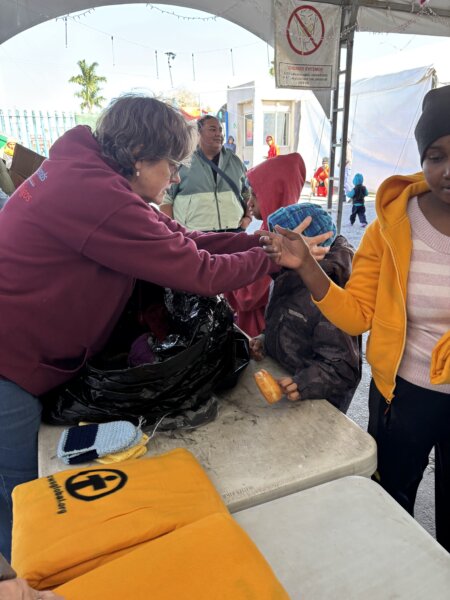 “We started really grassroots,” Rudnik said. “Several of us teachers from Brownsville Independent School District just started taking food, taking tote bags with snacks and water, toiletries, just little things.”
Rudnik did not stop there. “Gradually, over a period of weeks, we started making meals, taking dinner across the bridge,” she said. “We just used those beach wagons and hauled them across. It started with just one or two beach wagons, and by the time two years had passed, we were taking twenty beach wagons, and we were feeding a thousand people.”
Team Brownsville grew such that, within those first two years, hundreds of volunteers from all across the United States came to help. “Church groups, synagogue groups, civic groups, just individuals, and families that wanted to come,” Rudnik said. “They helped make a meal, [take] it across…[take] supplies across.”
In early 2019, the Migrant Protection Protocol (MPP) took effect, providing just another setback for those seeking asylum. Asylum seekers, both Mexican and non-Mexican, were sent to Mexico instead of their families or sponsors before they could finish their immigration processes.
“So we ended up with a huge encampment that had upwards of three thousand people in it,” Rudnik said. In these encampments were migrant people from all across Central and South America, Africa, Central and South Asia, and the Middle East.
Under the Biden Administration, the MPP was ended, and Team Brownsville continued its work up until recently. This past January, now under the second Trump Administration, Team Brownsville closed its doors.
“Texas is a very conservative state and many people are very anti-immigrant, including the governor,” Rudnik said. Gov. Greg Abbott “told the Attorney General to investigate organizations that work with migrants. So, we were investigated, and nothing came out of it…but our attorney just said ‘it’s better if you just shut down, it’s better for your own safety,’ and that’s what we did.”
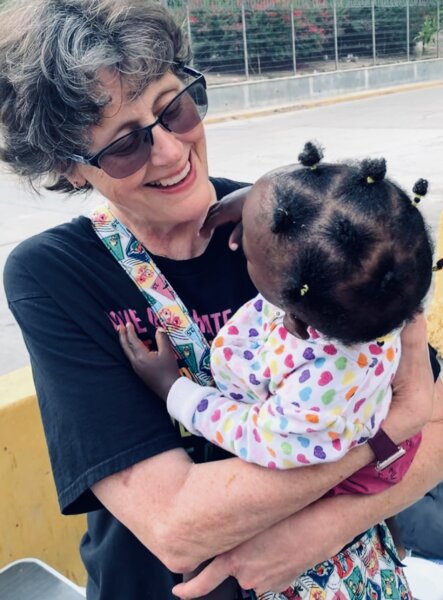 Today, Rudnik and the former leaders of Team Brownsville have reorganized themselves as the Madrinas de Justicia (Godmothers of Justice) and aligned themselves with Grannies Respond. Grannies Respond is a grassroots organization from Beacon, New York, that formed in 2018. Thirty Upstate grandmothers and their supporters banded together that same year to go on a two-thousand-mile road trip to McAllen, Texas, where they protested at the U.S. Border Patrol Processing Center.
The Madrinas de Justicia and Grannies Respond are now working to help families affected by the mass deportations across the nation. Rudnik is also working to help families in Brownsville. “We’re focusing on families that came through the border seeking asylum and stayed in Brownsville. But now all the asylum processes have been stopped, so they’re still here,” she said. “We’re trying to keep them safe…they don’t want to come out…they’re scared of getting caught by ICE.”
Despite the many challenges, Rudnik’s mission is far from over. She firmly believes it will be continued by the next generation.
“We are giving people a chance for a life that they want to live,” she said. “We are giving people they have made a choice to come to pursue asylum, to pursue a legal pathway into the United States.”
Work Cited
Smith, Kate. “Asylum denials hit record-high in 2018 as Trump administration tightens immigration policy.”
CBS News, 4 December 2018, https://www.cbsnews.com/news/asylum-seekers-asylum-denials-hit-record-high-in-2018-as-trump-administration-tightens-immigration-policy-as-the-caravan-arrives/. Accessed March 2026.
Photos courtesy Andrea Rudnik.

